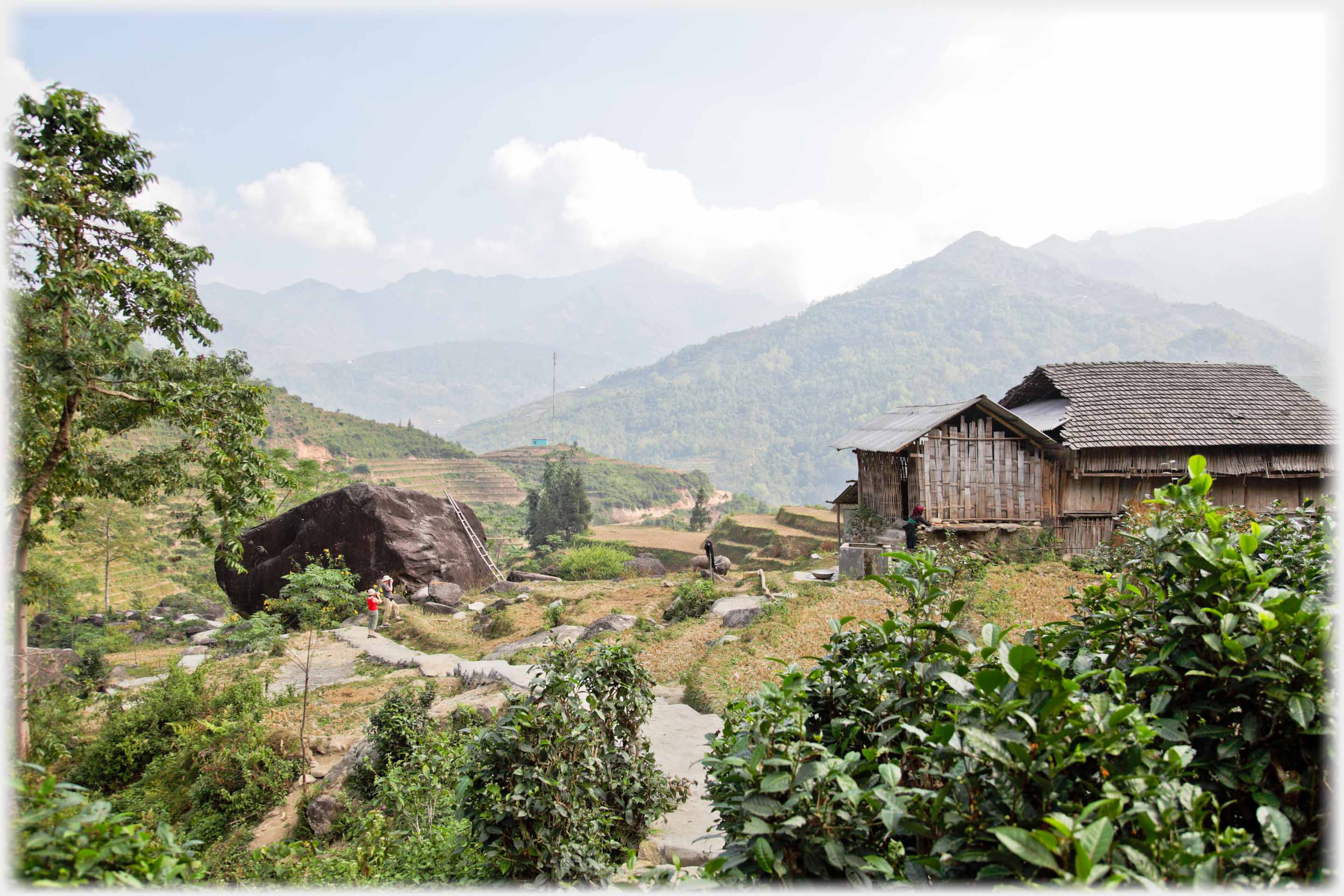
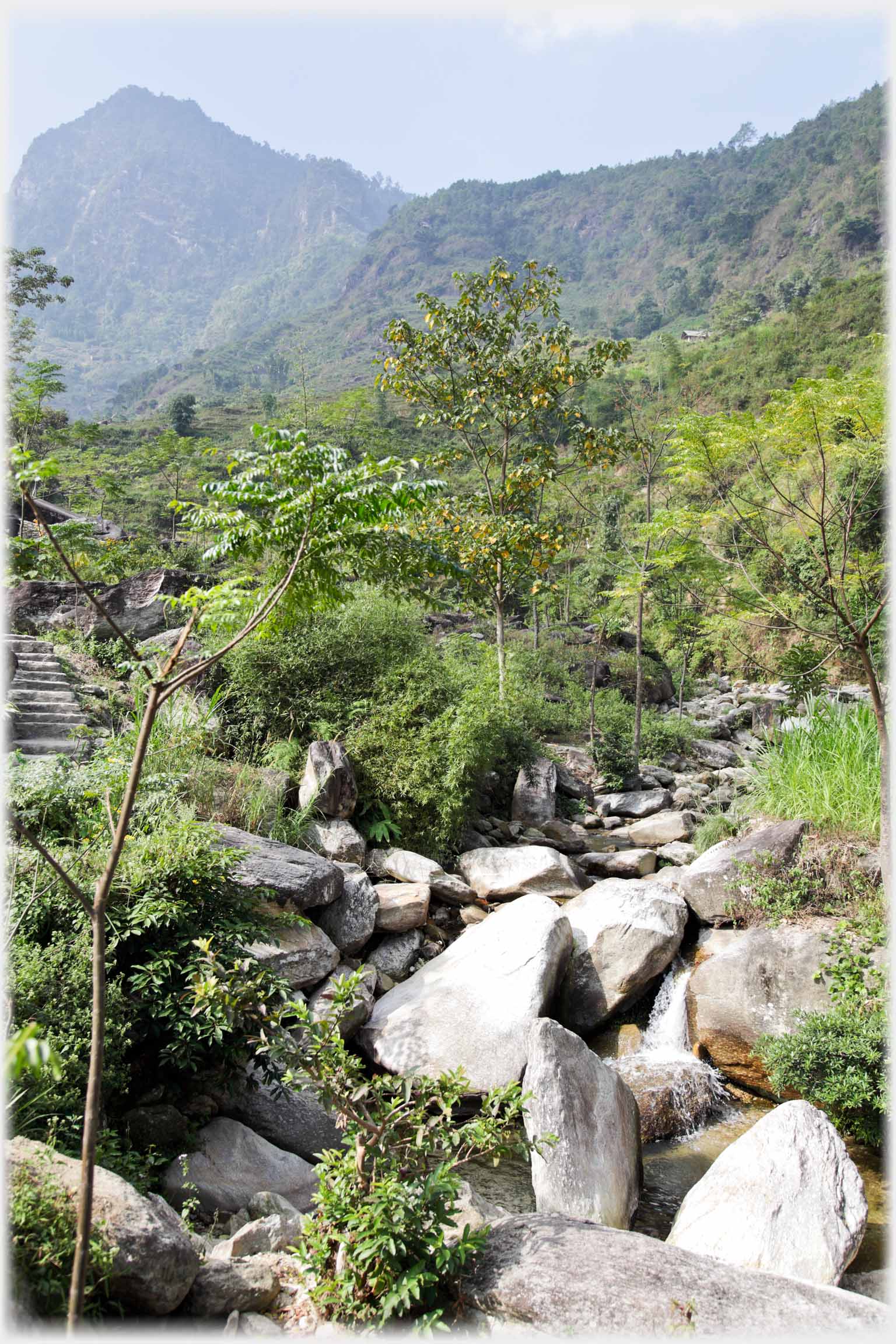
 This is the beautiful countryside in which the 'Rock Art' is located; ascending the ladder, onto the boulder, gives access to some examples
 Visitors enjoying the view without taking a step
The photographs on this page add to the last two pages by completing the circular tour to the east and south of Xín Mần, here the views are from the south of that town in Nấm Dẫn District. Just off the road that runs down to Quang Binh is an area with some 80 rock etchings. These belong with a similar type of carving found in Scotland, and other parts of Europe, and are collectively described as 'Rock Art' together with the more well known cave paintings. The similarity of these carvings, some 6,000 miles apart does not seem to have become an object of interest to pre-historians yet. And indeed, as the notice translated below makes clear, the Vietnamese authorities, so far, appear unaware of the age of the work.
Visitors enjoying the view without taking a step
The photographs on this page add to the last two pages by completing the circular tour to the east and south of Xín Mần, here the views are from the south of that town in Nấm Dẫn District. Just off the road that runs down to Quang Binh is an area with some 80 rock etchings. These belong with a similar type of carving found in Scotland, and other parts of Europe, and are collectively described as 'Rock Art' together with the more well known cave paintings. The similarity of these carvings, some 6,000 miles apart does not seem to have become an object of interest to pre-historians yet. And indeed, as the notice translated below makes clear, the Vietnamese authorities, so far, appear unaware of the age of the work.
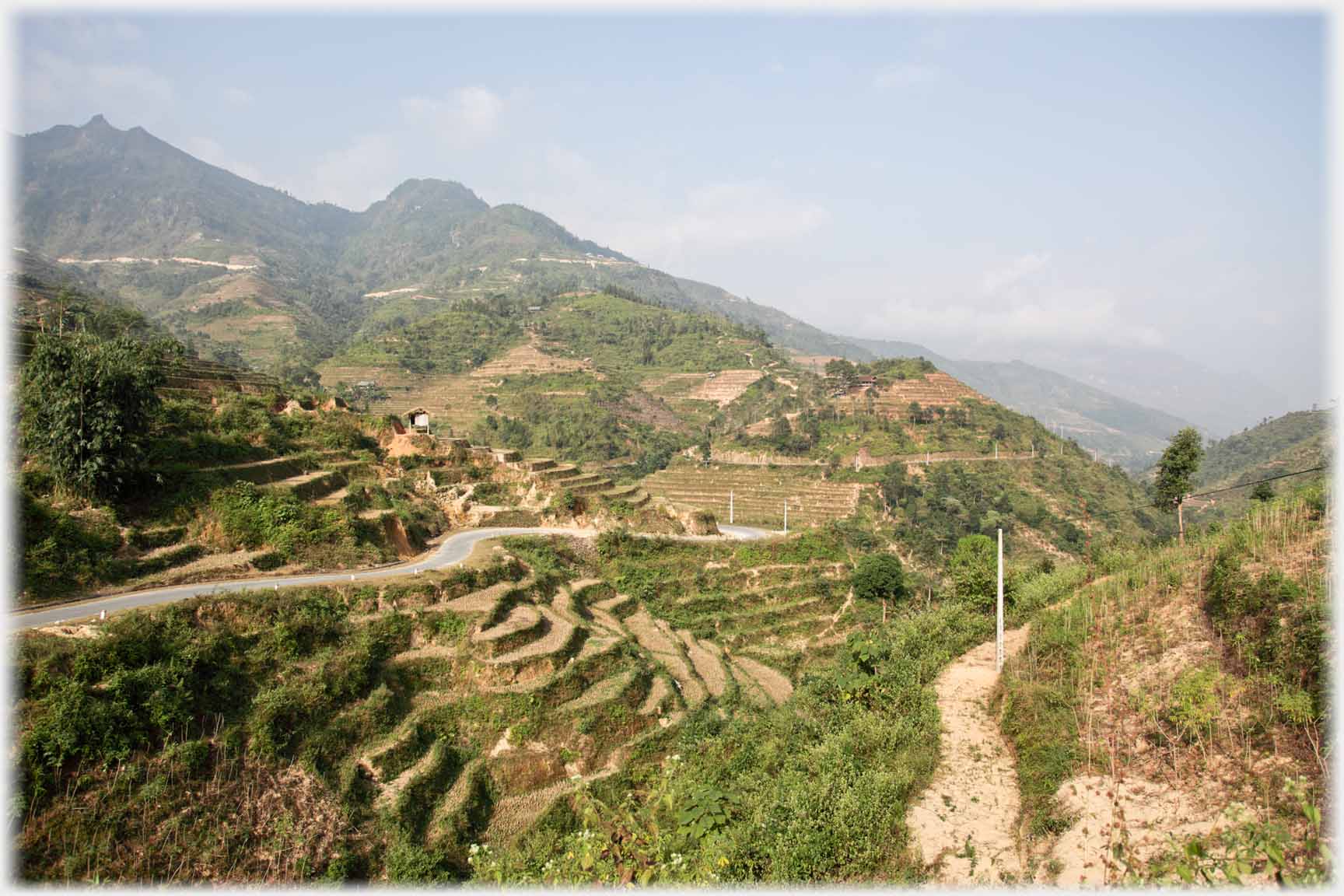 The hill outlines seen above are beside Xín Mần...
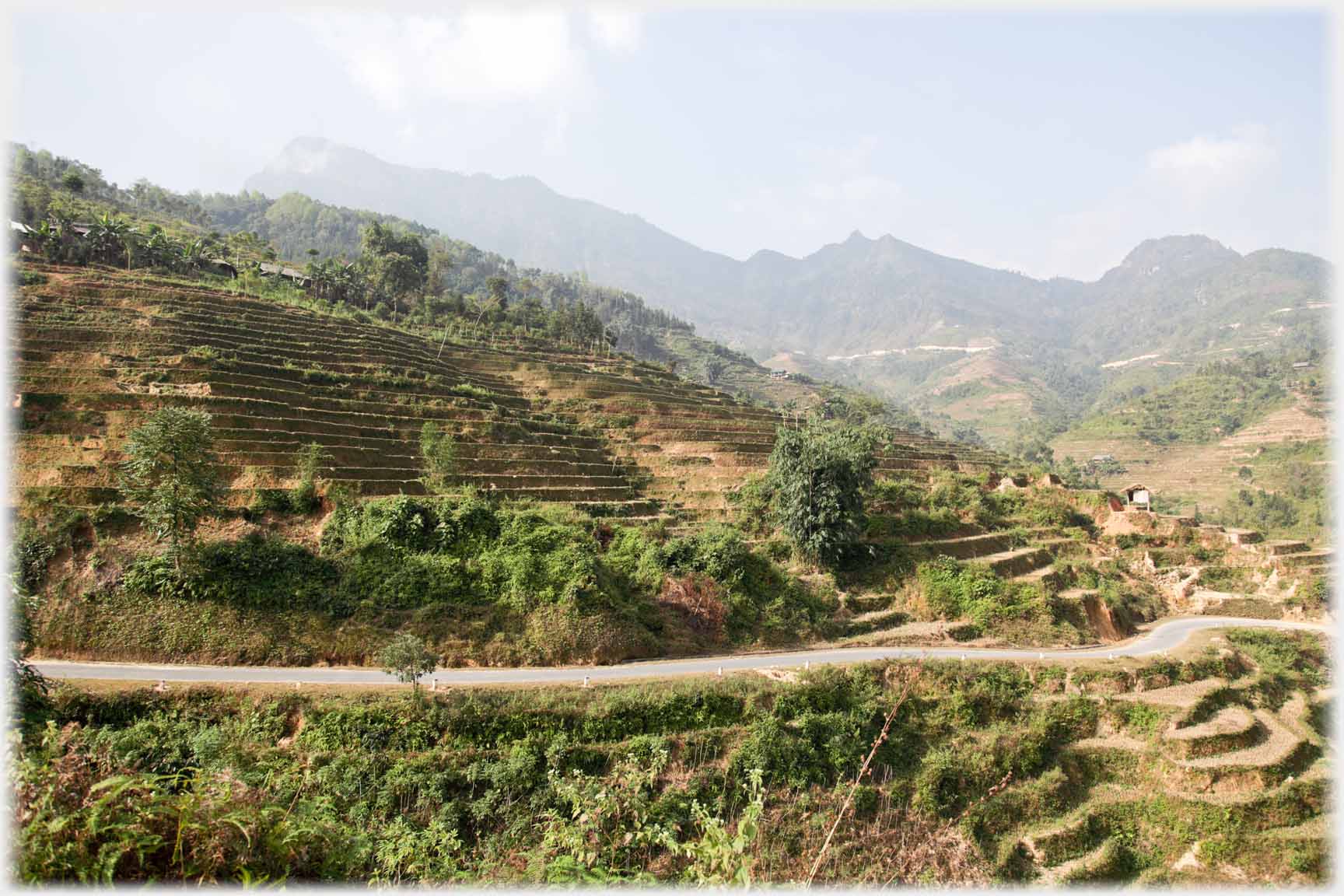 ...and become distant as Nấm Dẫn District is entered
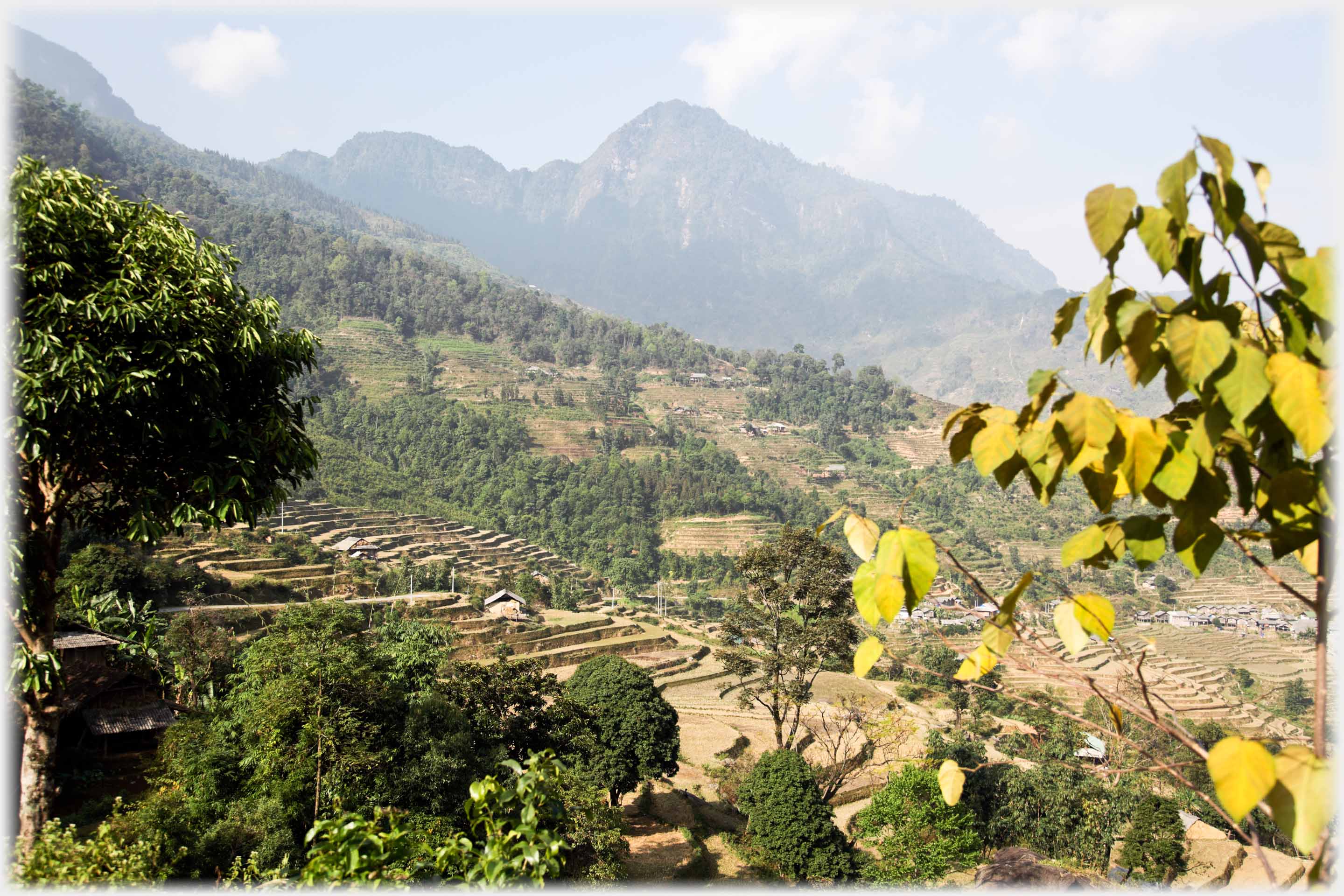 Typically, on these large hillsides, the terracing runs to the tree line
Three details of life in the area; visitors meet few small creatures in Vietnam, although a
scorpion
was spotted on a previous page.
Typically, on these large hillsides, the terracing runs to the tree line
Three details of life in the area; visitors meet few small creatures in Vietnam, although a
scorpion
was spotted on a previous page.
 A rather magnificent Blister Beetle
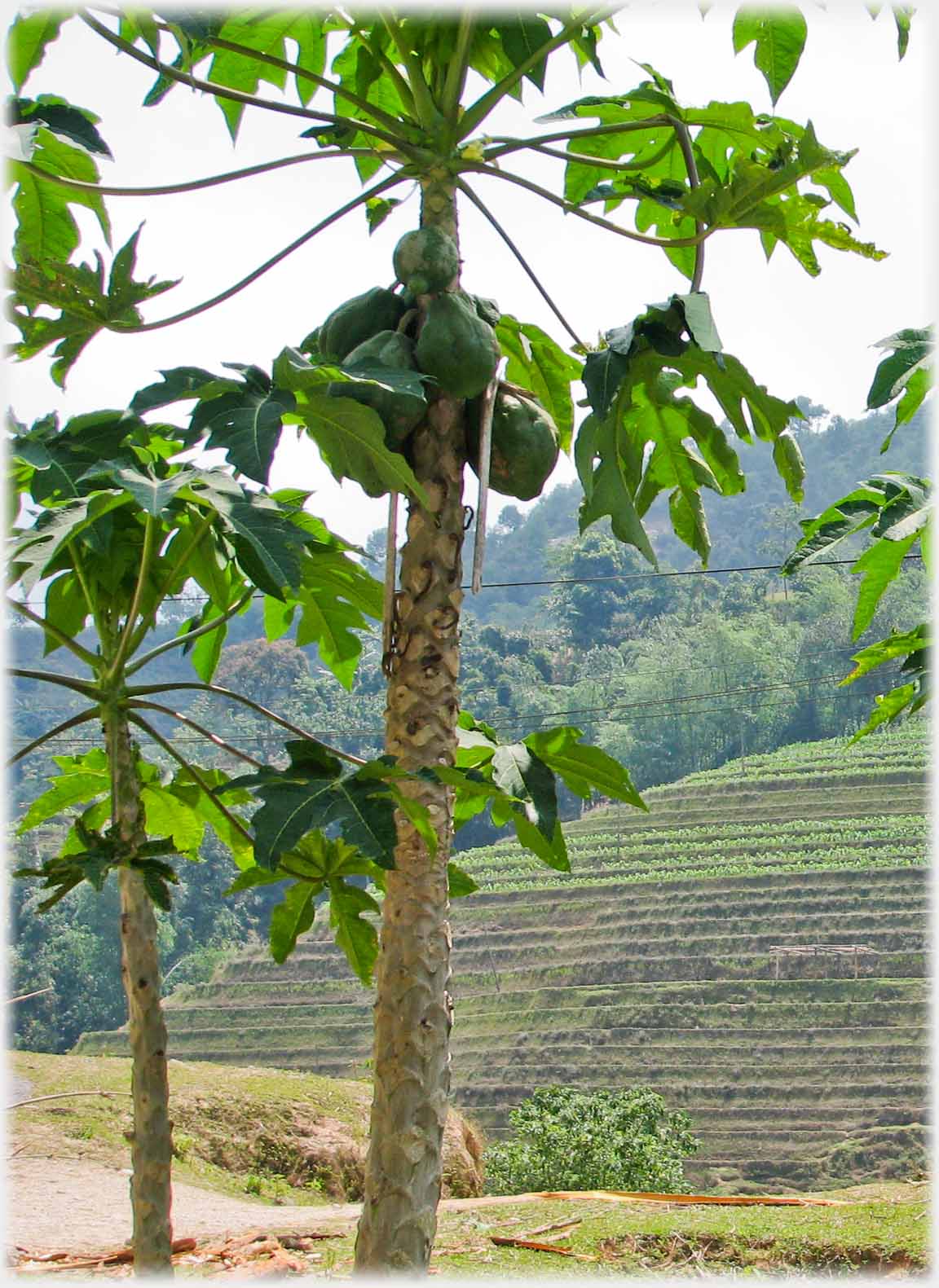 Papaya - originally from South America
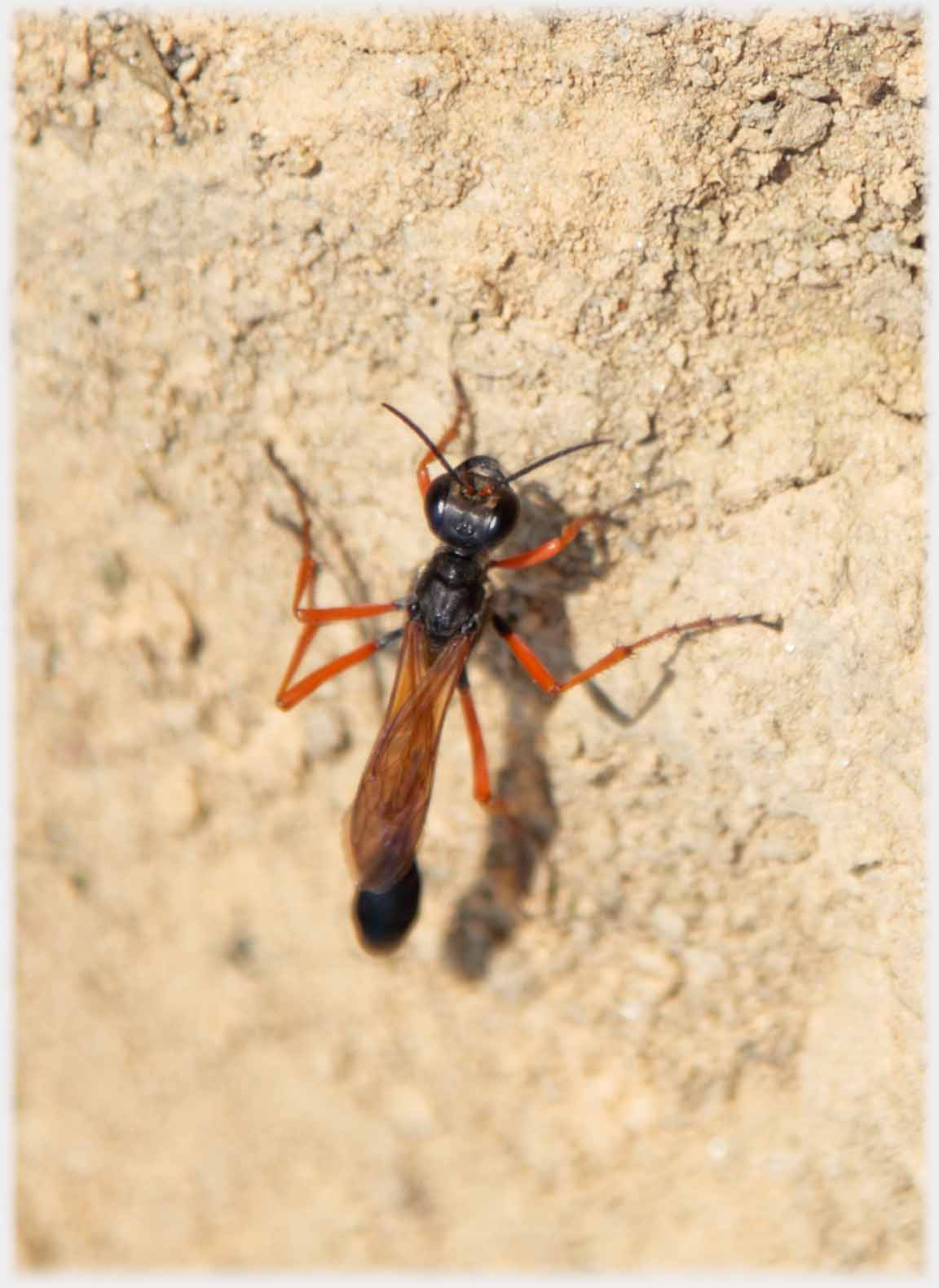 Not a red ant - black head and body
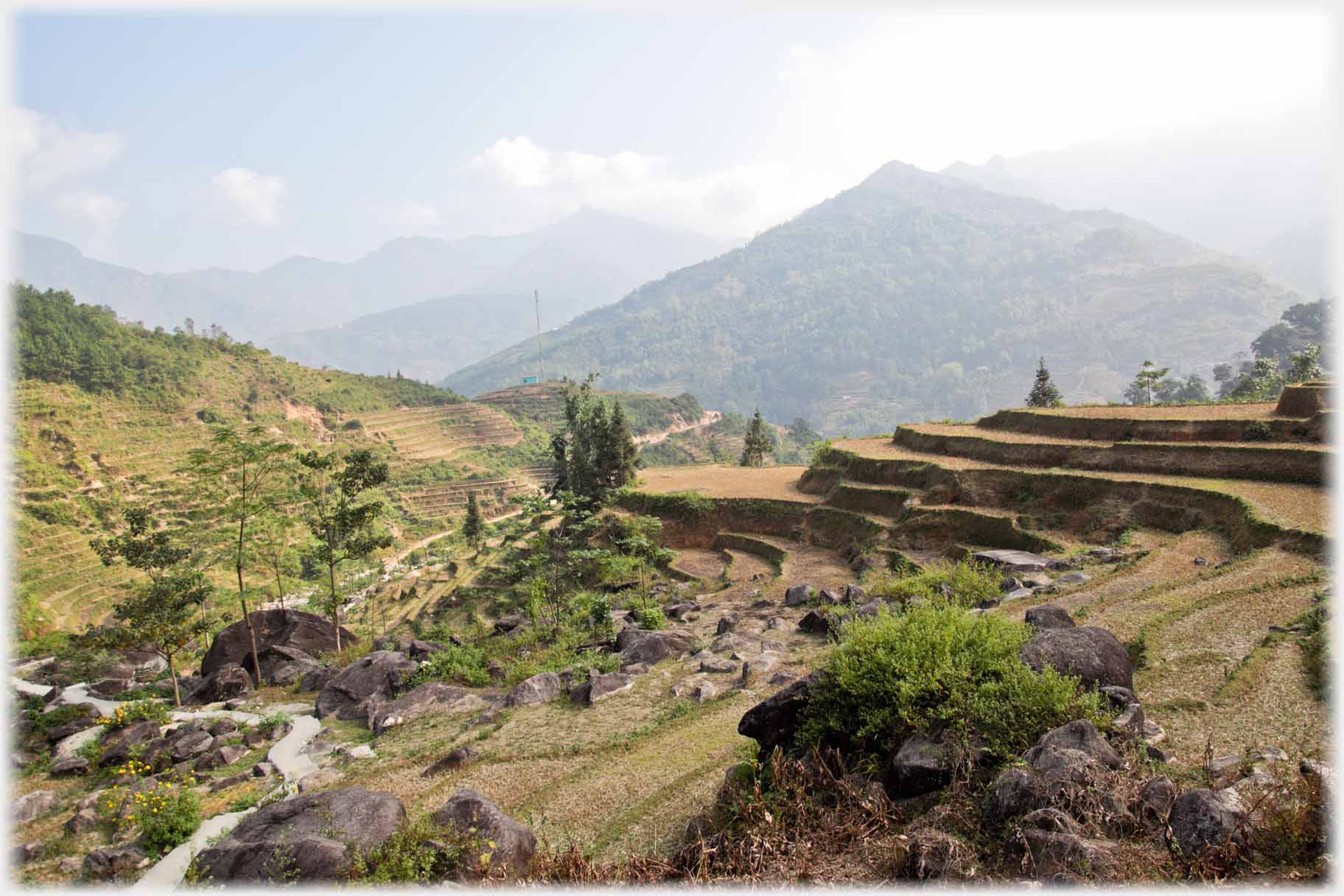 The country is a mixture of wilder lands and terracing
with habitation
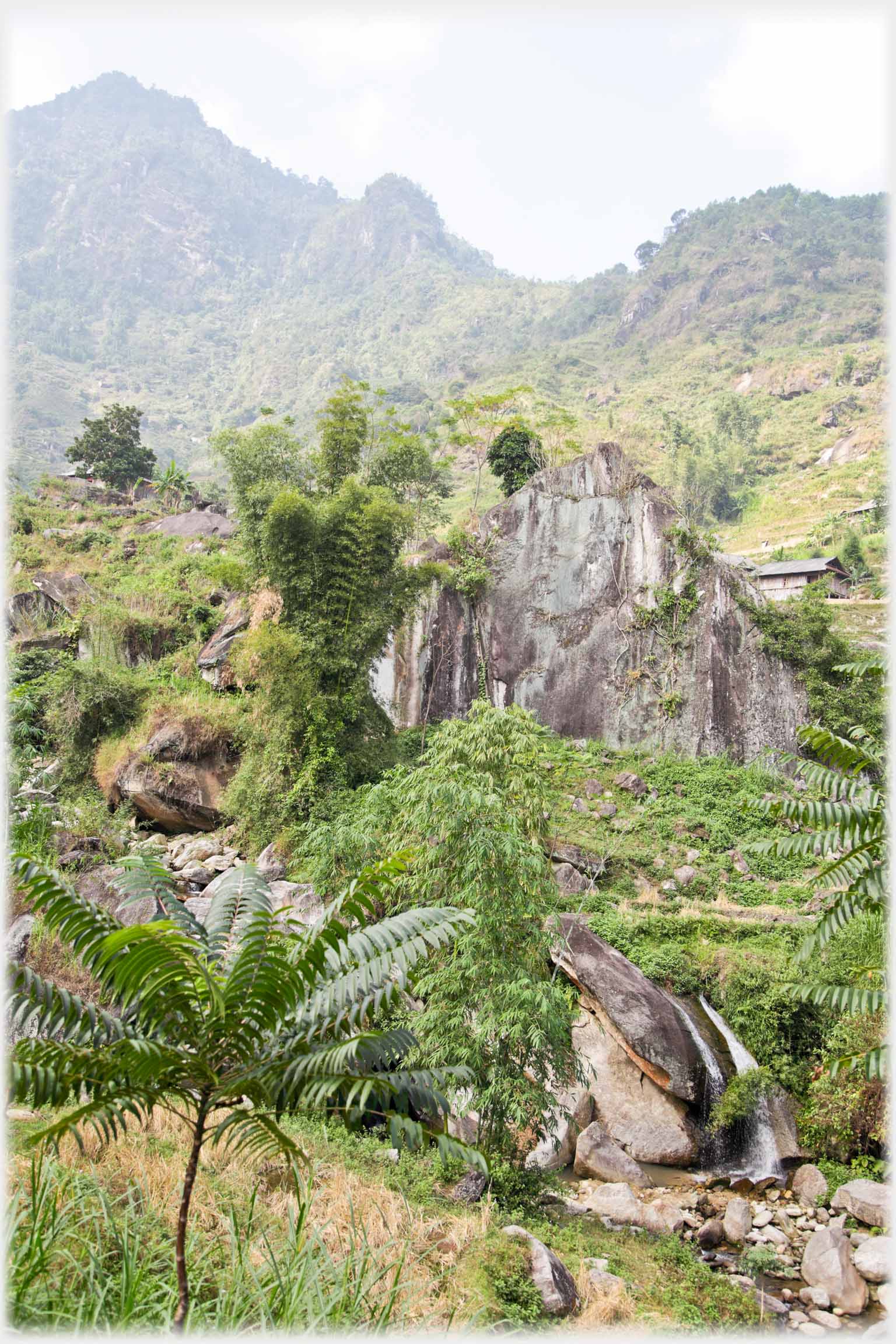 In some places the houses seem stranded in rough ground (right, centre)...
 ...but steps may be there to help (left, centre)
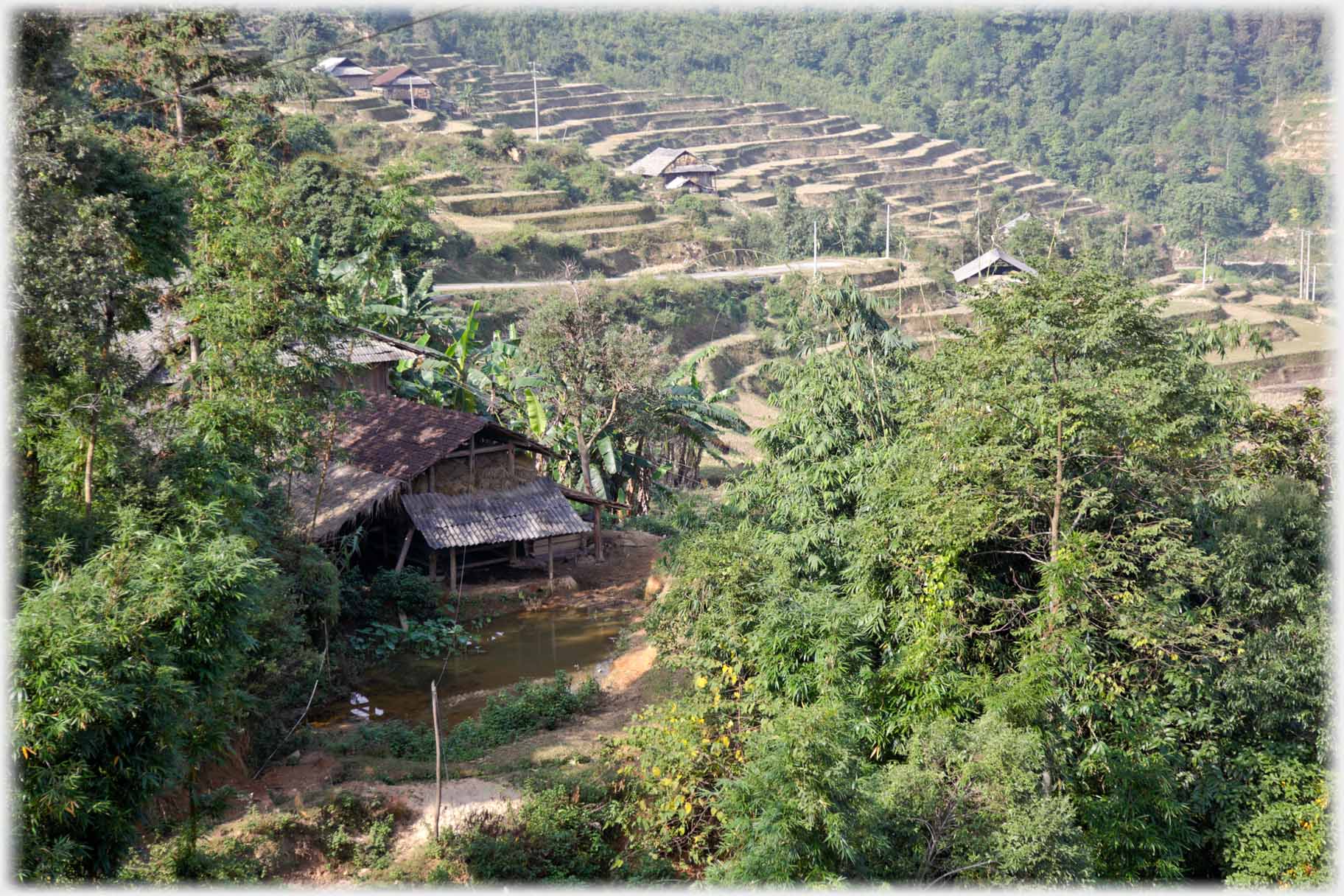 A house seeming to be in hiding
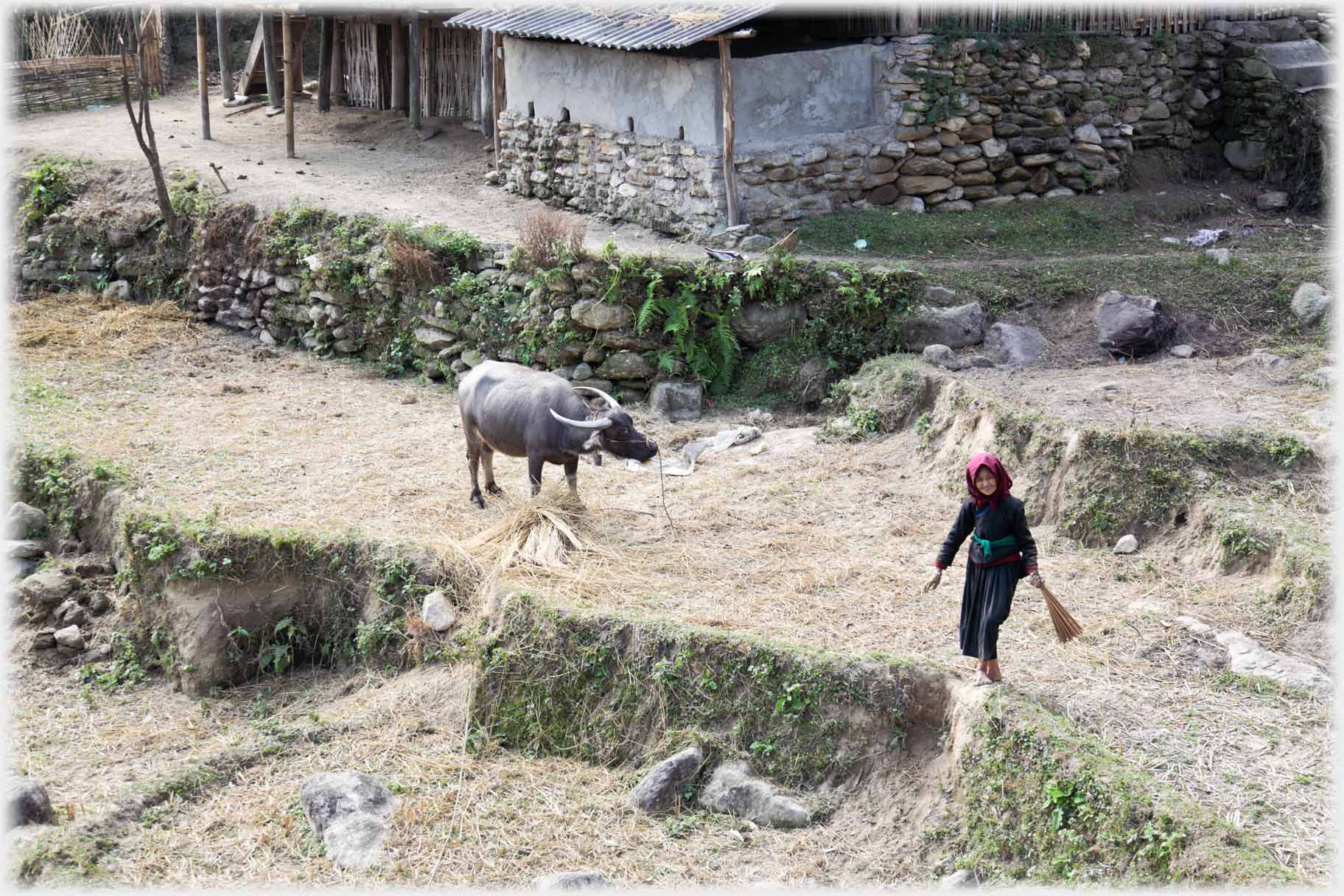
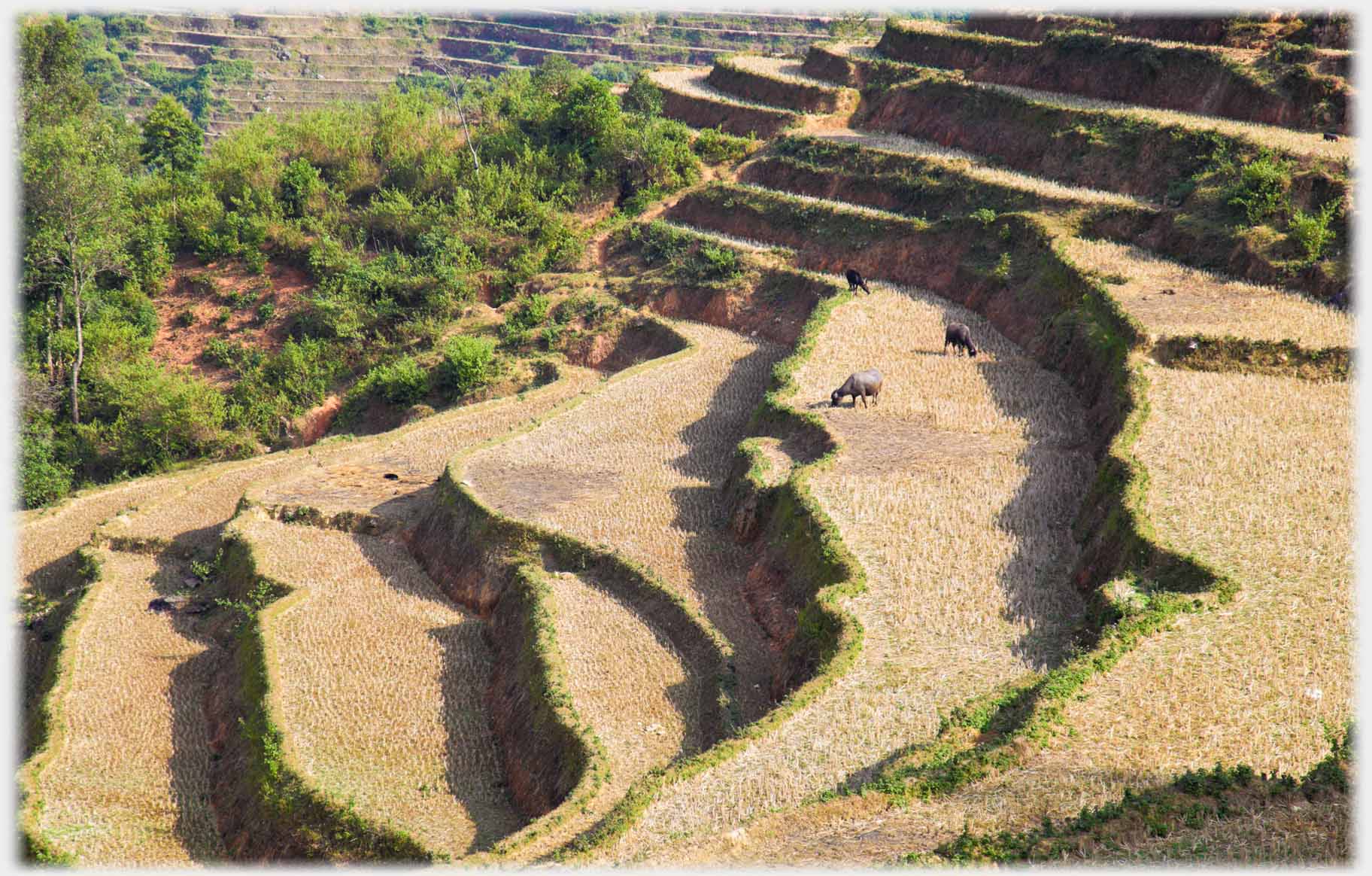 This shot lets the ubiquitous buffalo onto the page (distantly), finding the end of the seasons food on the terraces...
 ...And nearer - they are remarkably
docile
compared to some U.K. cattle, more inquisitive than defensive
...And nearer - they are remarkably
docile
compared to some U.K. cattle, more inquisitive than defensive
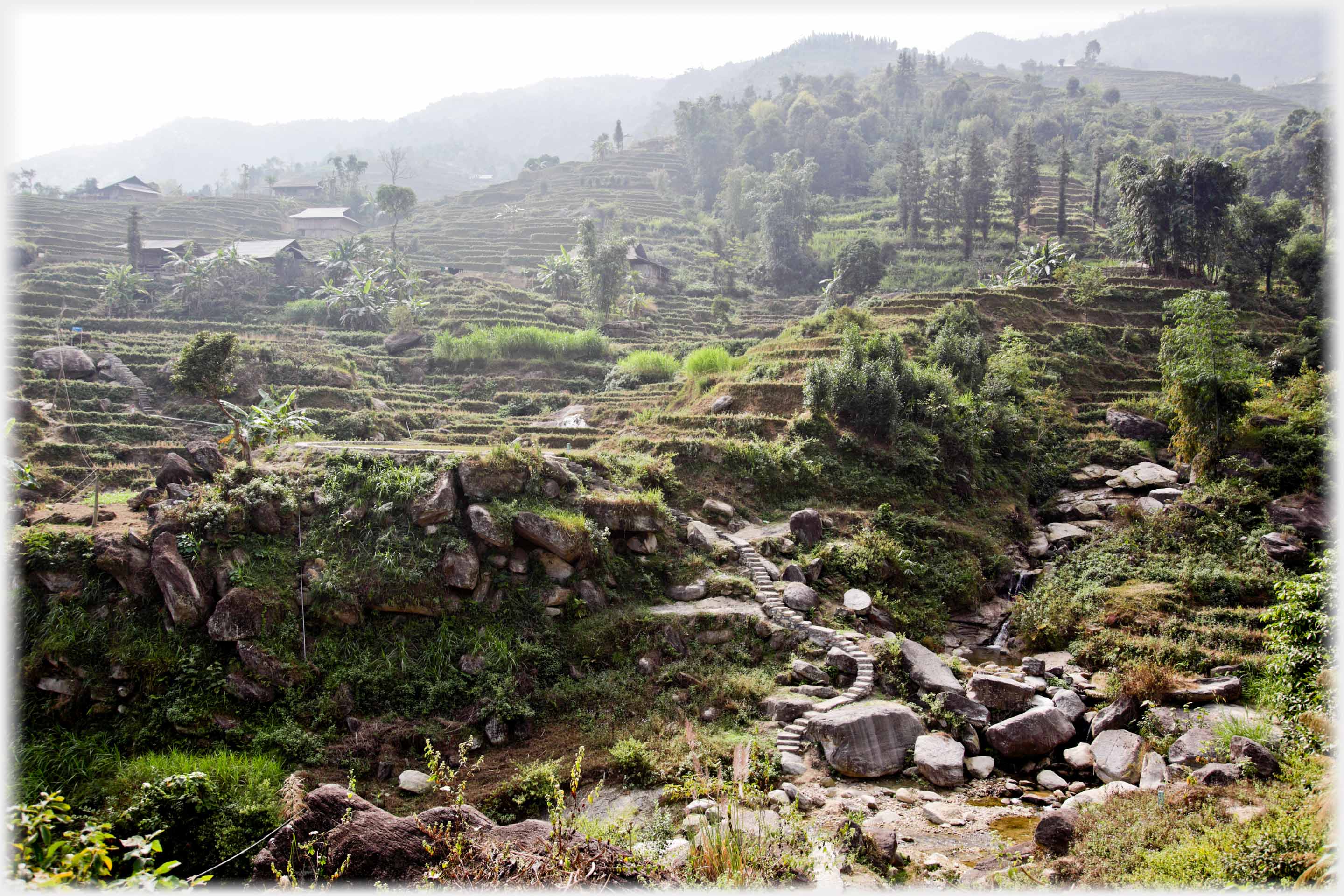 Winding steps setting off a jumbled landscape
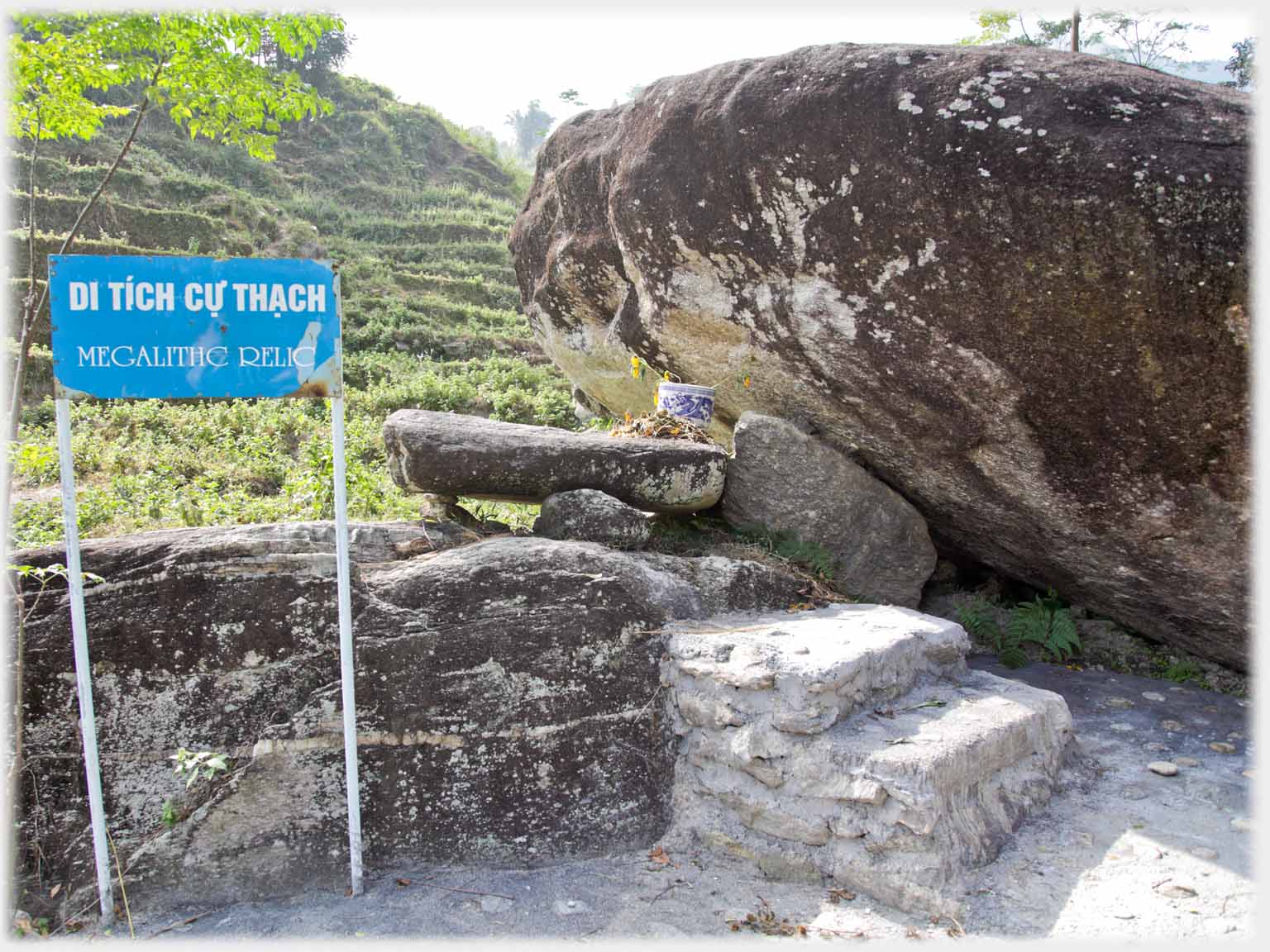 Then a rather brief, rickety sign, welcomes visitors.
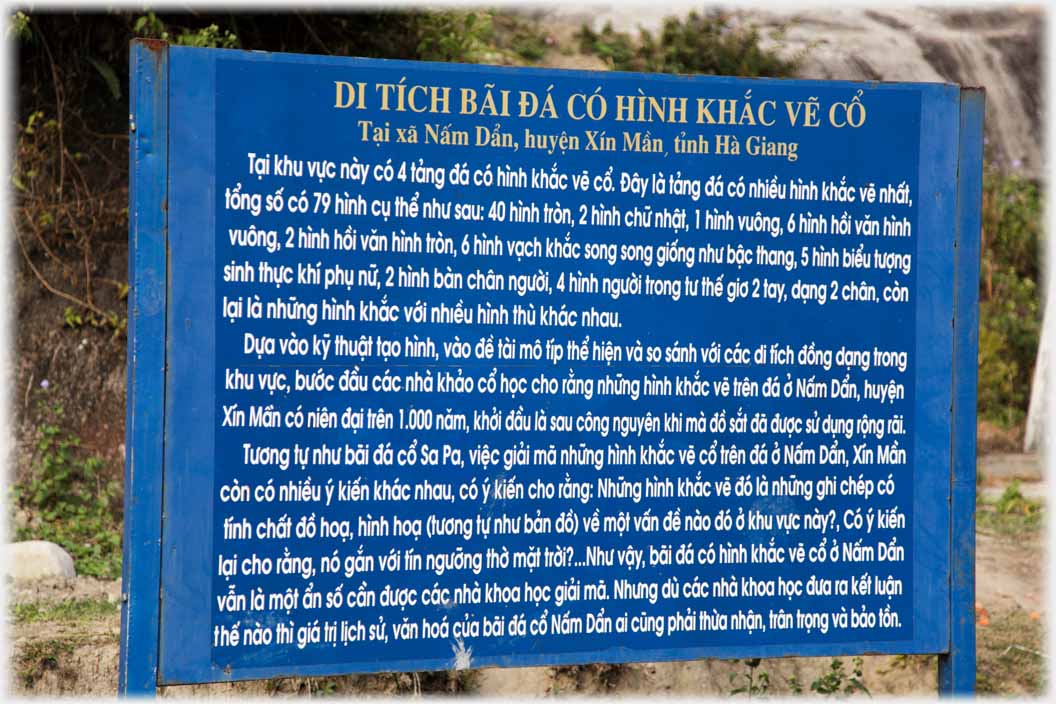 "In this area, there are four rocks with ancient carvings. This rock has the most carvings, with 79 specific images as follows: 40 circles, 2 rectangles, 1 square, 6 square spiral patterns, 2 circular spiral patterns, 6 parallel lines resembling steps, 5 female genitalia symbols, 2 human footprints, 4 human figures with arms raised and legs spread apart,
and the remaining carvings are in various other shapes. Based on the carving techniques, the themes and motifs depicted, and comparisons with similar at
"In this area, there are four rocks with ancient carvings. This rock has the most carvings, with 79 specific images as follows: 40 circles, 2 rectangles, 1 square, 6 square spiral patterns, 2 circular spiral patterns, 6 parallel lines resembling steps, 5 female genitalia symbols, 2 human footprints, 4 human figures with arms raised and legs spread apart,
and the remaining carvings are in various other shapes. Based on the carving techniques, the themes and motifs depicted, and comparisons with similar at
relics in the area, archaeologists initially believe that the rock carvings in
Nam Dan, Xin Man district, date back 1,000 years, beginning after the Common
Era when iron tools were widely used. Similar to the ancient rock carvings
in Sa Pa, there are differing opinions regarding the deciphering of the ancient rock carvings in Nam Dan, Xin Man. Some believe that these carvings are graphic or pictorial records (similar to maps) about a particular issue in the area.
Some suggest it's connected to sun worship? ...Thus, the ancient stone inscription at Nam Dan remains a mystery that needs to be deciphered by scientists. But regardless of the conclusions reached by scientists, the historical and cultural value of the ancient Nấm Dẩn rock formation must be acknowledged, cherished, and preserved by everyone." Right. Another sign gives more details, but beyond 'Megalithic Relic' only in Vietnamese. The translation maybe shows that long signs can be a bit vacuous.
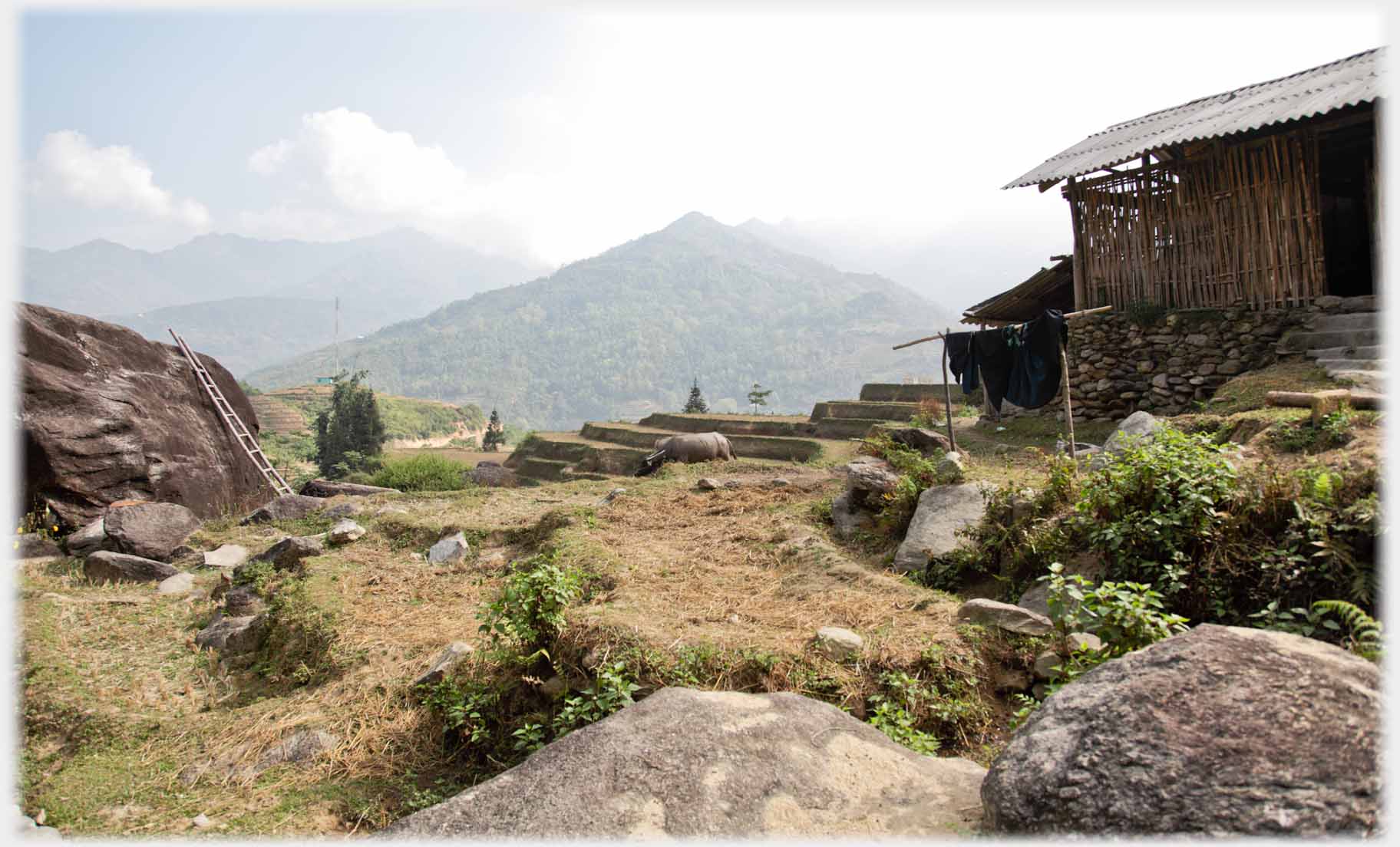 The farmyard area with its rock that has some 'relics' on it,
and its access ladder...
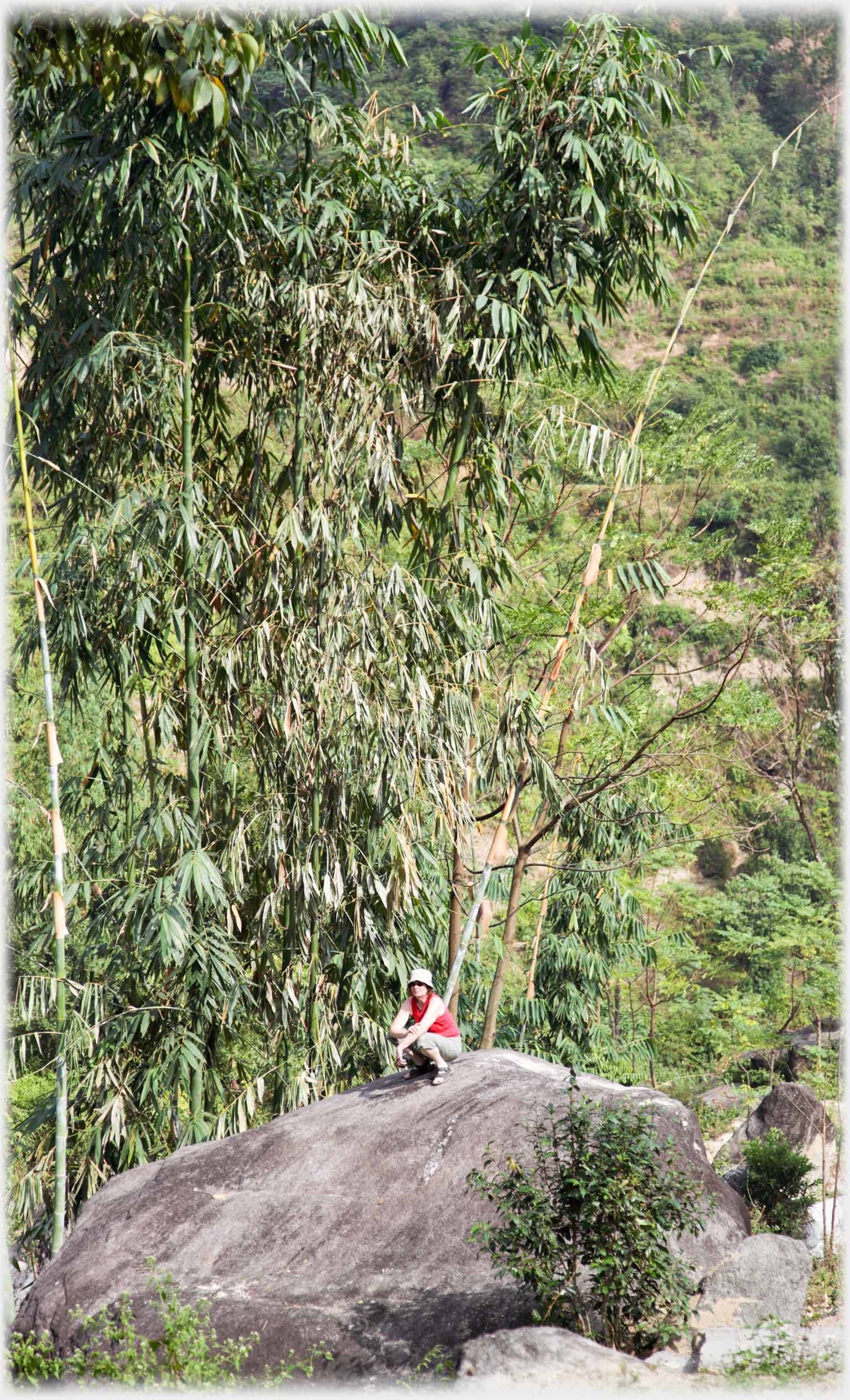 A visitor gives a sense of the size of the bamboo...
 ...that same yard as seen from the rock
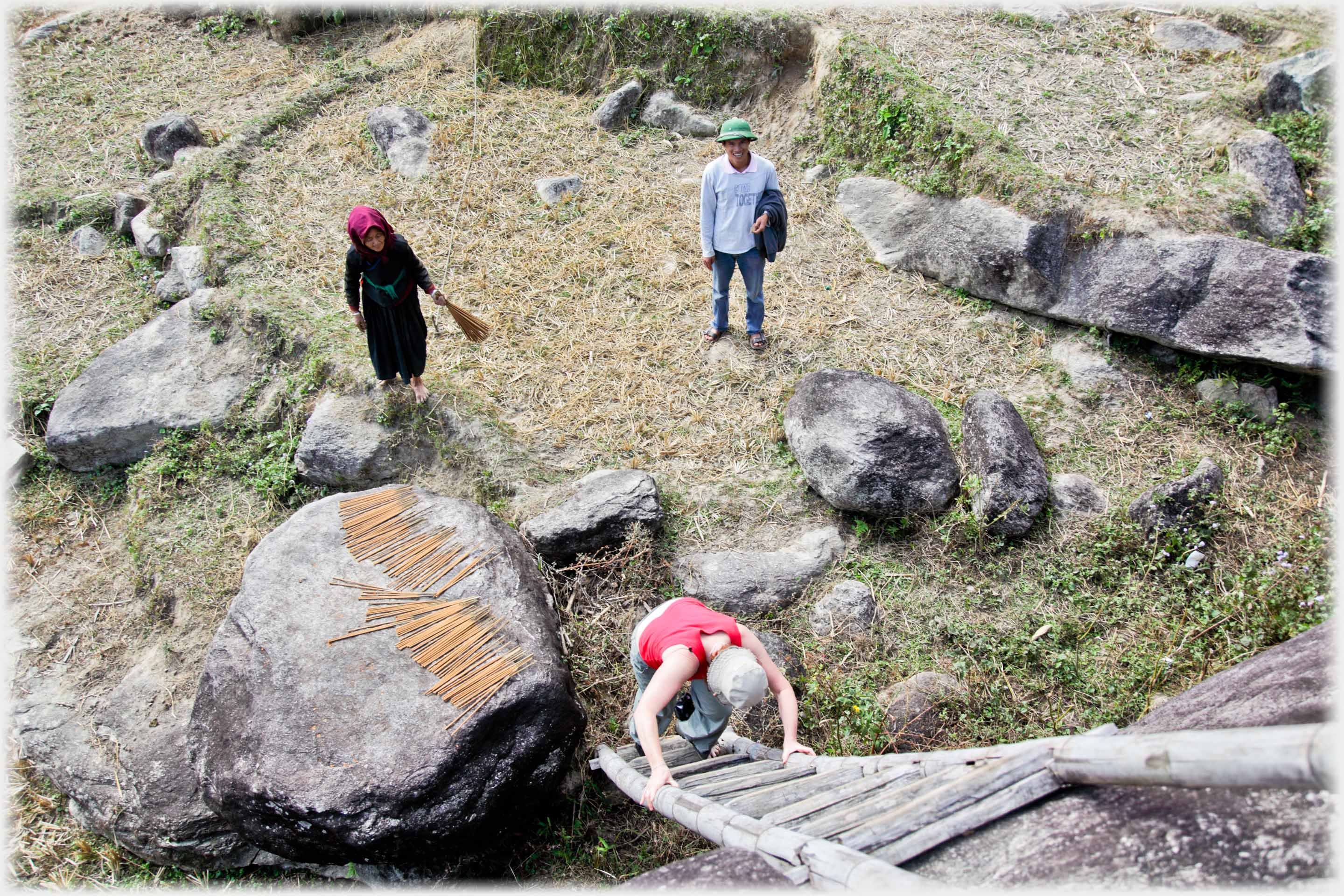 ...and that same visitor climbing that same ladder; watched with a certain amused tension
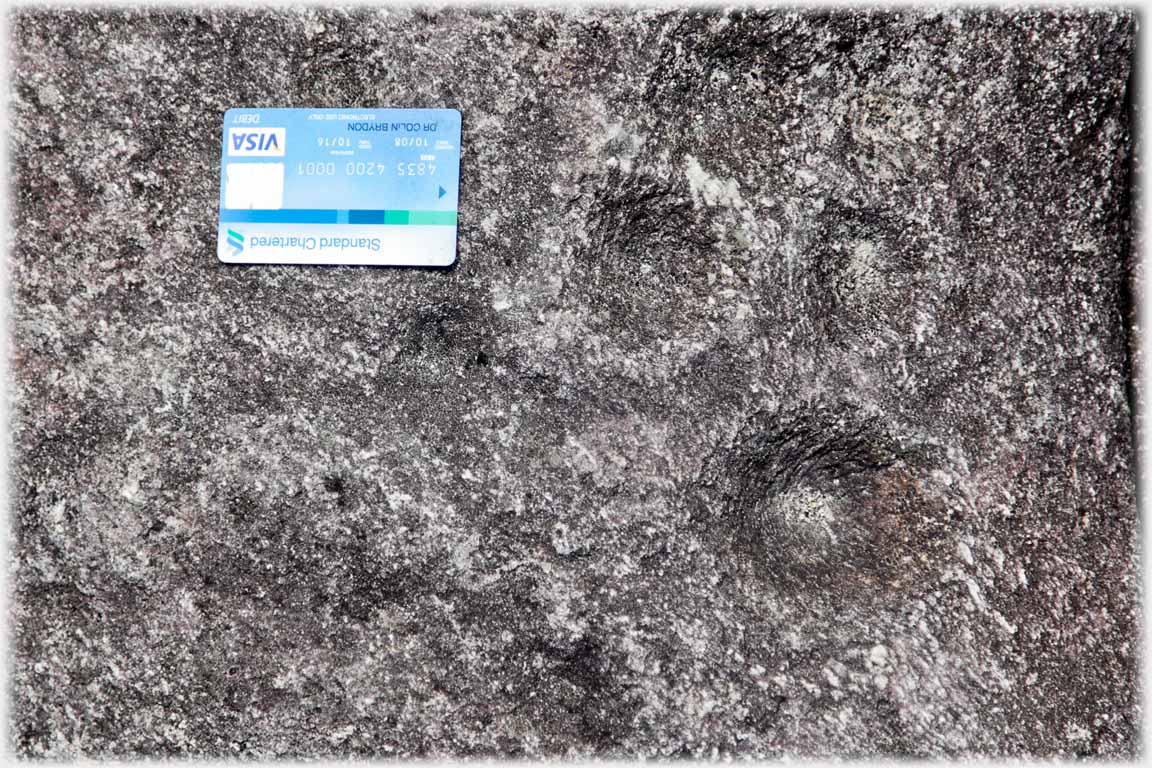 Cup and ring type markings from other...
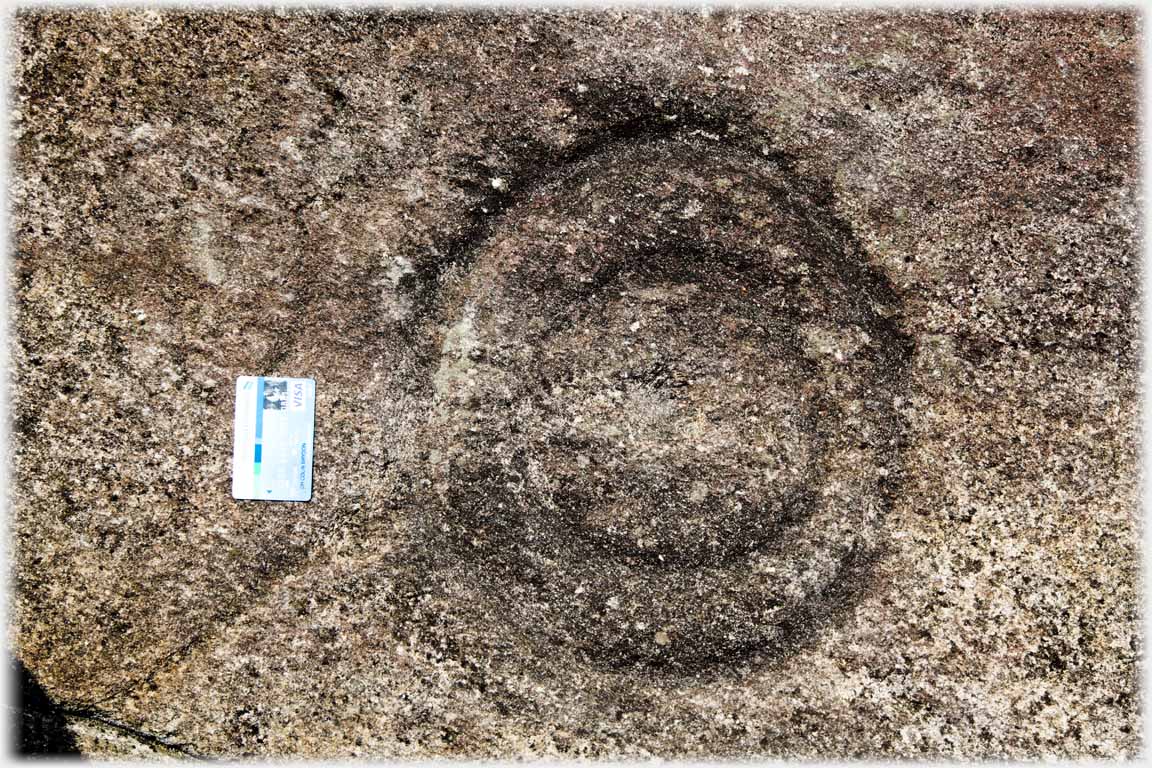 ...stones in the area. And then similar...
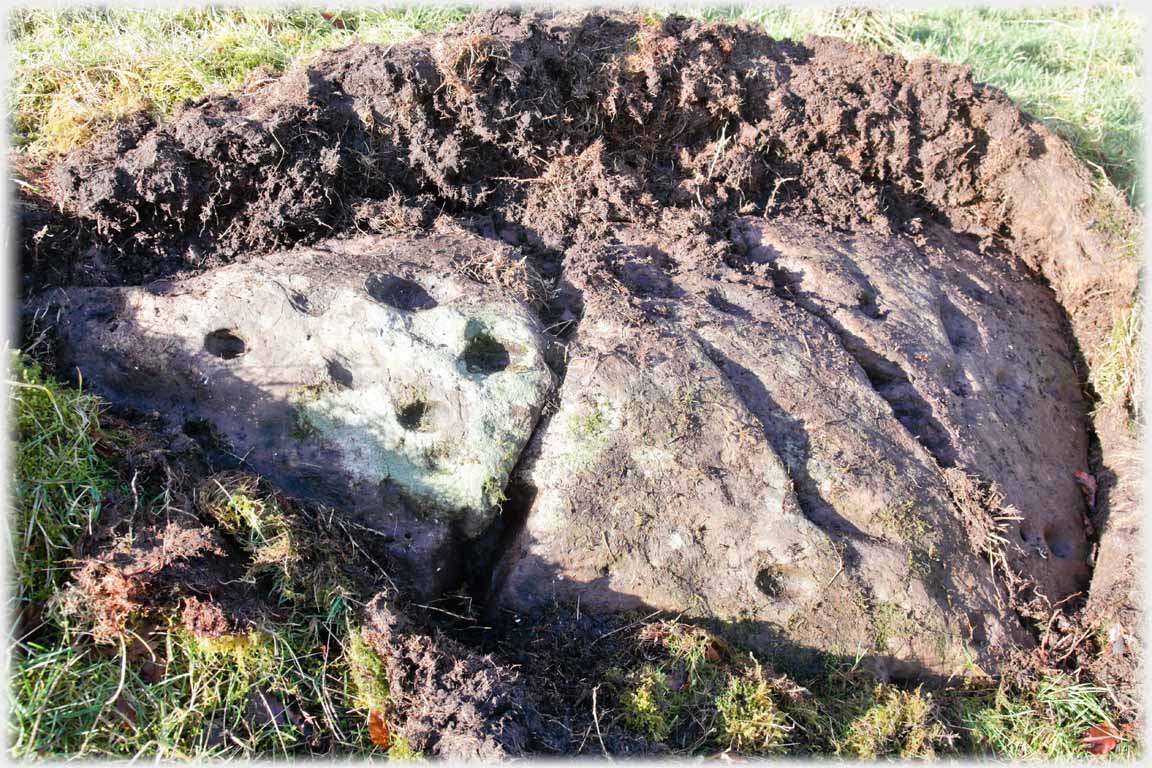 ...markings from Kirkcudbright in Scotland
 A practised poser surely?
 Also on the school run - rural Hà Giang style - a tin can rattle
 Near-by workers watch one another, and the those...
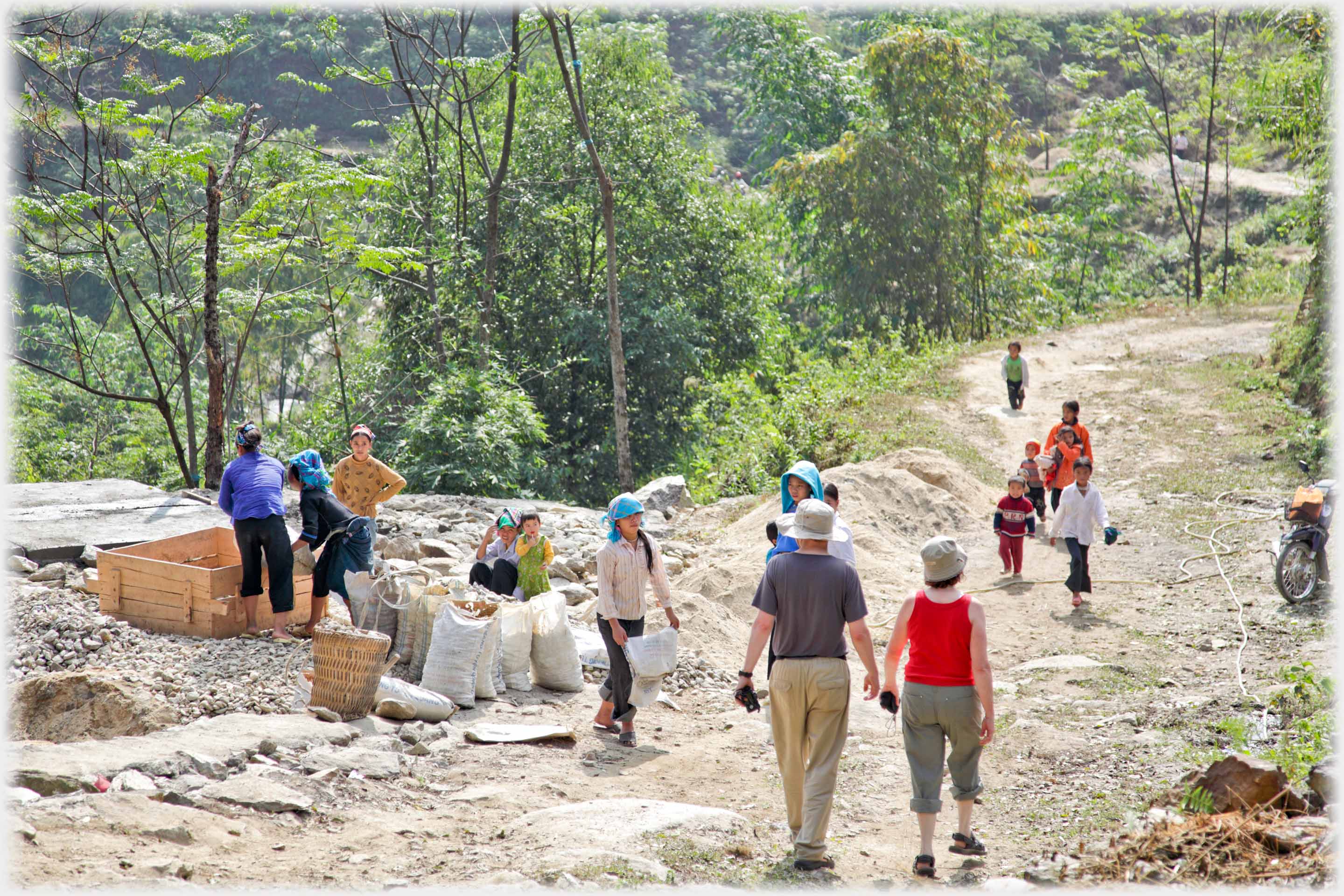 ...same visitors passing
Trailers...
 The next Picture Posting
page takes you to the town of Xín Mần.
The next Picture Posting
page takes you to the town of Xín Mần.
 The next page
of the Ruminations Section is to be headed 'Heron stand-off'.
The next page
of the Ruminations Section is to be headed 'Heron stand-off'.
Or go to the contents of the Ruminations Section.

 The last page's photos were from the road out of Xín Mần to the east
 To some wild horned animals on Mull in Scotland - no, not the seaweed
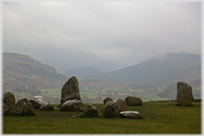 To some English Lakeland stones, but with no markings
 ...guide to this site