
Savannah Hypothesis
...according to the [Savannah] hypothesis, the partly generic preference today for this kind of landscape [stems from] ancient survival instincts. That may be so, but it will also strike many that the quoted description conforms remarkably closely to characteristic eighteenth-century landscaping traditions, epitomised in the work of ‘Capability’ Brown (1716-83), which have been widely disseminated though the western world as ideal landscapes.
Malcolm Andrews (1999)
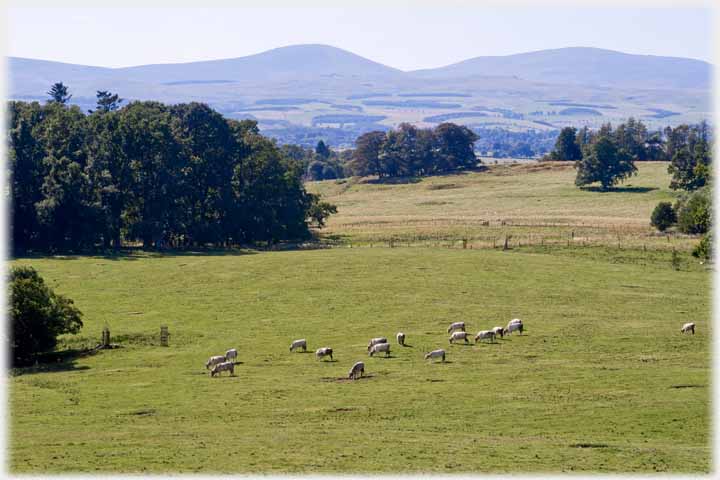
Surveys have demonstrated that, shown different landscape images, people overwhelmingly favour one form in particular, one of open grassland interspersed with trees and a view to the horizon, and if possible water, and animal and bird life [ - the Savannah Hypothesis]; ... we might have developed attachments to certain landscape features so powerful that they become hard-wired in our genes and are with us today.
Michael McCarthy (2015)
The Savannah Hypothesis brings together anthropology, psychology and genetics by suggesting that human needs were, at one time, met within landscapes like the one above, and this has left its mark deep within us. These wild Chillingham cattle, being possible food, are in a good place for us to engineer dinner. The
idea
 More in general on explanations.
is attractive, especially in being brought to bear on aesthetics, where we lack convincing accounts of sources for our aesthetic
predilections.

Accounting for aesthetics is not easy.
However, Andrews seems right to remind us of cultural explanations; hard wired to certain locales, humans would lose the very flexibility
genetics
 An important amplification of evolutionary theory.
gave them which allow faster adaptation than other species. From trees, where we were for far longer, to the savannah, and on to cities, where many people seem totally at home, the ability to adapt is what our DNA
gave us:

Levels of abstraction in explanations.
the ability to instruct our children and not wait on inheritance. Genetics, in important matters, has rendered us independent from genetics.
The Andrews quote is from page 19 of Landscape and Western Art published by Oxford University Press. The McCarthy quote comes from page 59 of The Moth Snowstorm published by John Murray.
The photograph of the Chillingham wild cattle, was taken in 2023. Their park, where they are very largely left to be as wild as they originally were, is in north Northumberland, where records indicate that their home has been for at least 400 years.
Above, hovering on blue introduces a link: click to go, move away to stay.

Saturday 31st January 2026
 ...guide to this site