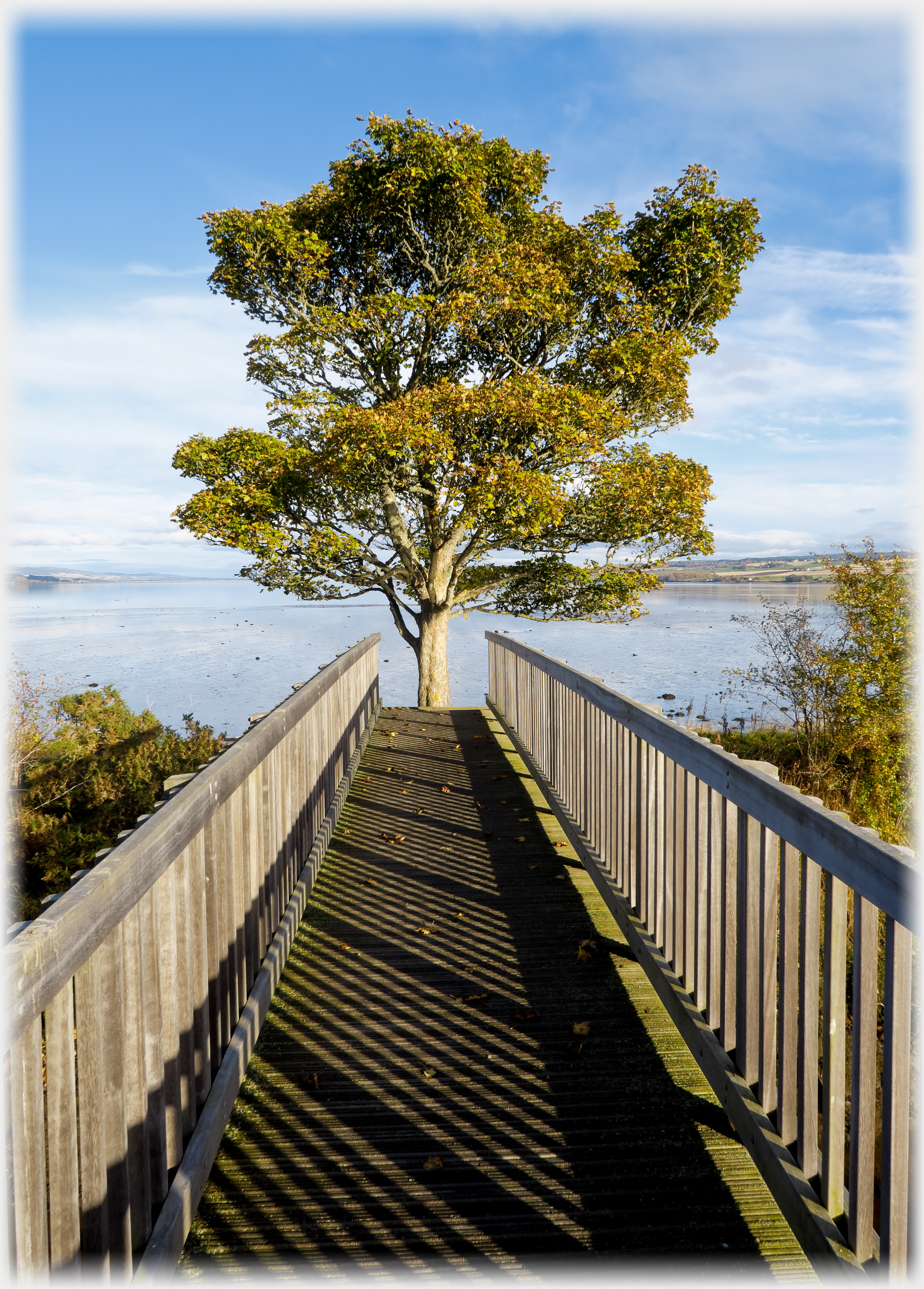

Juxtaposing human geometrical shapes against the fluidity and burgeoning of nature, can enhance both. Here, at the least, the symmetry of the rails and centrality of the tree is eye catching. Is there a general point we can discern in the apposition above? The human contribution seems much simpler than the natural one. Rectangles and lines can do a lot of work describing the bridge, but none for the tree. We seem to have a short-hand which is associated with human endeavours, and which helps us delineate the bridge. Maybe what is happening here is that the creative endeavour of construction, reflects back a way we have of perceiving the world. Every tree differs greatly from every other tree, but we would be stymied if we had to cope with such complexity - too busy processing detail to ever climb it. The tree we see, is a relatively simple object compared to the tree we might examine further. Our perceptions are governed by Stereotypes, generalities if you like, which summarise what we encounter, and make us able to act. As we perceive the world, so in turn, we construct a simpler one; bridges and all. Perception and conception accord.
Stereotypes and caricatures form key elements in the way our thinking works.
The photograph is of James’s Bridge which was opened in 2019. Standing near Dingwall, in northern Scotland, it spans the, somewhat abandoned, canal that runs the mile down to the harbour. The canal’s construction was completed 200 years previously by Thomas Telford.
The picture was taken with a Canon PowerShot G5 X on 06/11/22 at 2pm. 1/250th at f/7.1 ISO rated at 125. Focal length: 24mm (35 mm equiv)..

Saturday 23rd May 2026
 ...guide to this site