
Taking Everything
Our problem was that we couldn’t afford to stand still, and our father had to make money. He took something that should’ve gone to the curlews and gave it to me. It’s not as if he saw that as theft because the birds could always go somewhere else. Reseed this land or plant that hill and the curlews will just move if they don’t like it. It never occurred to us that we were taking everything. So I stood and listened to their songs and heard a whisper of my own guilt.
Patrick Laurie (2021)
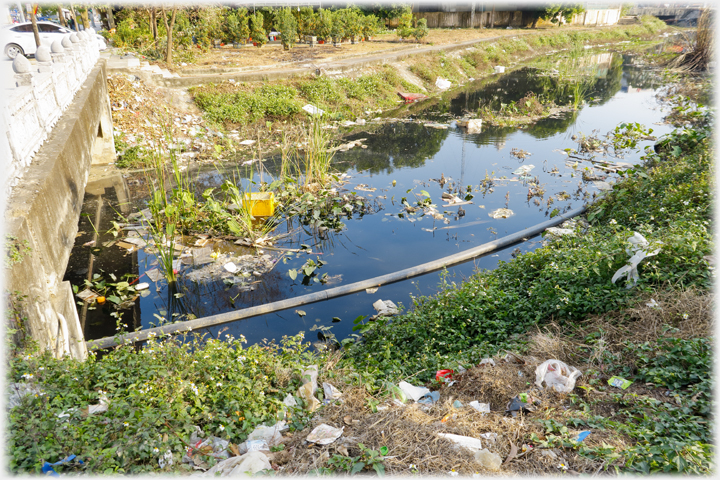
The photo is of a small river running through the centre of the town of Tĩnh Gia, in northern Vietnam. It is a mess. The problem is people here could not
afford
 Inequality lies near the base of many of our current problems.
to stand still, they had to make money. It never occurred to them that
growth
Inequality lies near the base of many of our current problems.
to stand still, they had to make money. It never occurred to them that
growth
 How do we see the way that we are living beyond our limits?
has a limit - beyond which we cannot go. Taking; using; destroying in the belief that there is plenty in this wide world - for us all. A belief shared everywhere. Laurie’s account comes from a corner of Scotland; he farms in the place his forebears
farmed.
 Laurie’s account is very much about locus our lives have in a community network.
The
non-human
Laurie’s account is very much about locus our lives have in a community network.
The
non-human
 Distinguishing the human from the non-human, does not lessen human total embeddedness..
is symbolised by the curlew from whom we are robbing everything. So much so that the haunting trill of their cry has all but gone from the land. There seemed no limit. Rubbish is simply moved out of sight. But ultimately there is a limit; nowhere left for it to go. We have hit the limit; the sound of our guilt is now deafening.
Distinguishing the human from the non-human, does not lessen human total embeddedness..
is symbolised by the curlew from whom we are robbing everything. So much so that the haunting trill of their cry has all but gone from the land. There seemed no limit. Rubbish is simply moved out of sight. But ultimately there is a limit; nowhere left for it to go. We have hit the limit; the sound of our guilt is now deafening.
Laurie’s book is called Native and the quote is from page 91 of the Birlinn paperback edition. It is impressive, maybe not so much for its writing style, but for its determination to give an account of the contradictions inherent in any real life, and especially in the one he offers of the intertwining of past, family, the land and the mess we are making of it. It reeks of truth.
The photo was taken in 2025 just beside the main municipal buildings in the town that was called Tĩnh Gia, but which changed its name on the way to becoming a city that now stretches for 25 kilometres. The rubbish is far from atypical. Worrying about such matters has to take, as it did in Scotland, second place to economic development for poorer countries and people. Any such pollution is insignificant compared to that created by the United State and other rich countries.
Above, hovering on blue introduces a link: click to go, move away to stay.

Saturday 17th January 2026
 ...guide to this site