
Feedback Loops
...the “cybernetic hypothesis” [is] that the fundamental building block of the nervous system is the feedback loop. The psychologist was interested in reflexes because he thought they might provide the units needed to describe behaviours. But simple reflexes have been inadequate. ...the unit should be the feedback loop itself. ... the reflex should be recognised as only one of many actualizations...
George Miller, Eugene Galanter and Karl Pribram (1960)
...natural selection has acted to produce organisms that are equipped with a huge variety of homeostatic, or ‘feedback’, mechanisms that serve to protect the organism’s integrity and reproductive capacity against the vagaries of a constantly changing environment, so enhancing the chances of survival. ... In very general terms then, biology makes use of two types of concept: physico-chemical laws and feedback mechanisms.
Jeffrey Gray (2004)
Circles
 Slippery constructions that haunt our metaphysics.
abound in thought and some indeed are vicious, but allies, like arcs, loops and spirals, are commonly innocuous. Miller et al were seeking to disentangle psychology from the straight-jacket (beloved by the Behaviourists) of the reflex arc. It was demoted to but just another example of the ‘feedback’ mechanisms found in cybernetics. Decades later Gray, approaching from a very different direction, saw consciousness as part of a biological system that was based in both physical, and, quite independently, cybernetic laws. Natural selection requires, at base, that material laws of physics and chemistry are, 'indifferent'* to potential developmental
pathways:
 A page introducing the idea of developmental pathways.
evolution is only possible if it is not totally dictated by particular physical states. In consciousness, physical sensations provide information for feedback loops, but do not dictate outcomes. While such ‘loops’ are innocuous and are fundamental to consciousness, it is a small step in abstraction, one that Kant took, to see consciousness as a
vast circle
A page introducing the idea of developmental pathways.
evolution is only possible if it is not totally dictated by particular physical states. In consciousness, physical sensations provide information for feedback loops, but do not dictate outcomes. While such ‘loops’ are innocuous and are fundamental to consciousness, it is a small step in abstraction, one that Kant took, to see consciousness as a
vast circle
 Conceptually the biggest of all circles is this world in which we live.
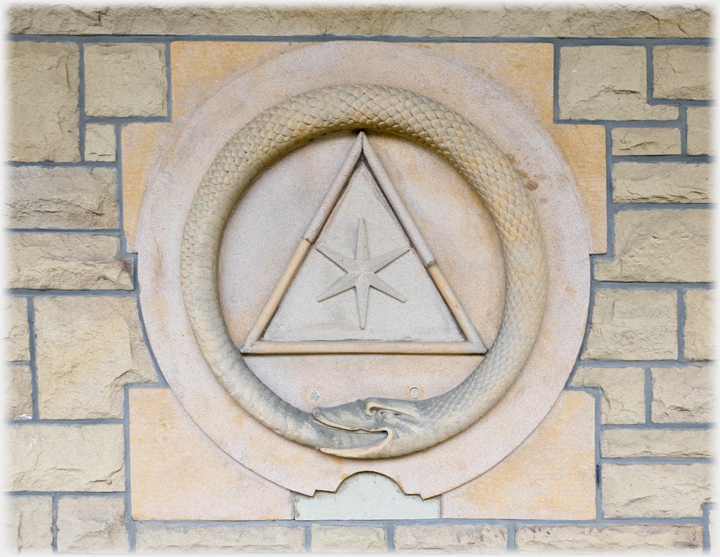
of spirals. Then the far less innocent shadow of the Uroboros and the
Suckophant†
Conceptually the biggest of all circles is this world in which we live.
of spirals. Then the far less innocent shadow of the Uroboros and the
Suckophant†
 Circles start to seem extremely vicious when we reach high levels of abstraction.
do indeed fall across our thinking.
Circles start to seem extremely vicious when we reach high levels of abstraction.
do indeed fall across our thinking.
Miller et al’s ground breaking book, Plans and the Structure of Behavior was published by Holt Rinehart and Winston inc., the quote comes from pages 27 and 33. Gray’s book Consciousness: creeping up on the hard problem , published by Oxford Press, has these lines on pages 29 and 33. *In discussing DNA, Gray notes that the bonds that form from the four bases, A T C and G, are a matter of indifference to chemistry - page 28. †Sucko-phant (from ele-phant) is an animal in Yellow Submarine that eats everything and then itself.
This example of an Uroboros is by the entrance to Glasgow University’s Kelvin Building. It was brought from Lord Kelvin’s father’s house in the 1950s. The Uroboros is taken to represent wholeness and infinity, also, Wikipedia adds, the cycle of eternal renewal; the star symbolises balance, and the unity of opposites
Above, hovering on blue introduces a link: click to go, move away to stay.

Saturday 14th March 2026
 ...guide to this site